The agentic operating system for your business — what we mean, and why it's different
"AI-powered" is on every landing page now. Here's the specific, unglamorous architecture that lets an agent actually run your work instead of chatting about it.

Ievgen Krasovytskyi
Founder, StoryOS ·
Every software company shipped an AI feature this year. Most of them are a chat box in the corner that can summarize the thing you’re already looking at. That is not what we mean when we call StoryOS an agentic operating system for your business, and the difference is not marketing — it’s architecture.
Here is the claim, stated plainly: your business is a set of connected records — clients, projects, deals, content, tickets — and the work is moving those records forward. An agent that can read that structure, write to it safely, and be triggered by events in it can do a meaningful share of that work. A chat box that can only see the current screen cannot. The whole design of StoryOS follows from taking the first sentence seriously.
The workspace is the memory
Large language models are brilliant and stateless. Everything an agent “knows” about your business has to come from somewhere on each run. The industry’s default answer is to stuff context into the prompt — paste the doc, dump the thread, hope the right facts are in the window. That’s brittle, expensive, and it forgets everything the moment the conversation ends.
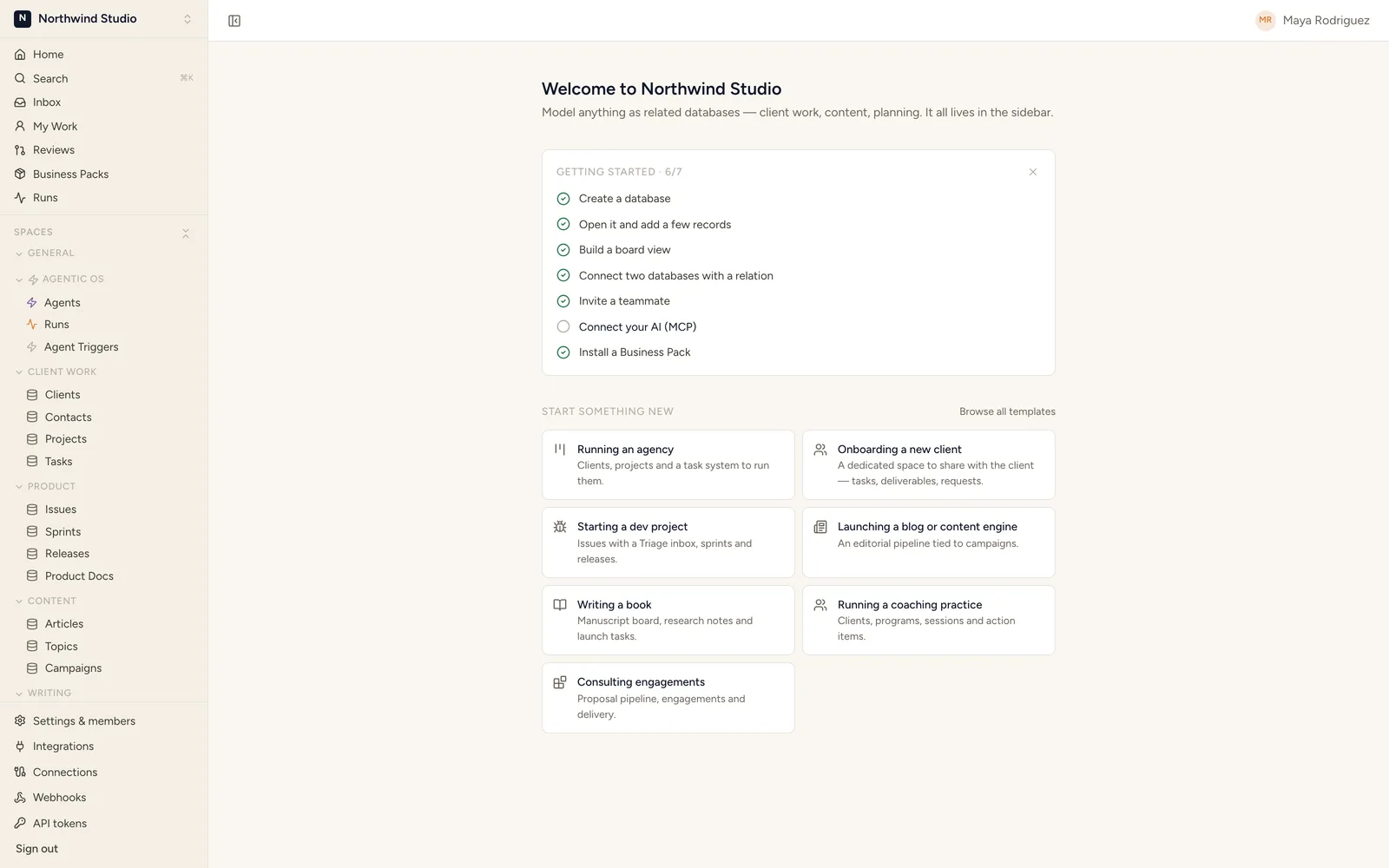 The workspace is the memory: every database the agent can reach, in one connected system.
StoryOS gives the agent durable memory by default, because your workspace is the memory. The clients database is who you work with. The projects database is what’s in flight. The relations between them are the facts that would otherwise live in someone’s head. When an agent needs to know which deliverables are at risk for Acme Corp, it doesn’t reconstruct that from a chat log — it queries the same records your team edits every day. The state is real, shared, and always current.
The MCP is the hands
Memory without the ability to act is just a very good notetaker. StoryOS ships a Model Context Protocol server, which is the boring, load-bearing part of the whole idea. Through it, Claude or ChatGPT gets a small, honest set of tools: describe a database, query records with structured filters, create and update and link records, run a button, leave a comment.
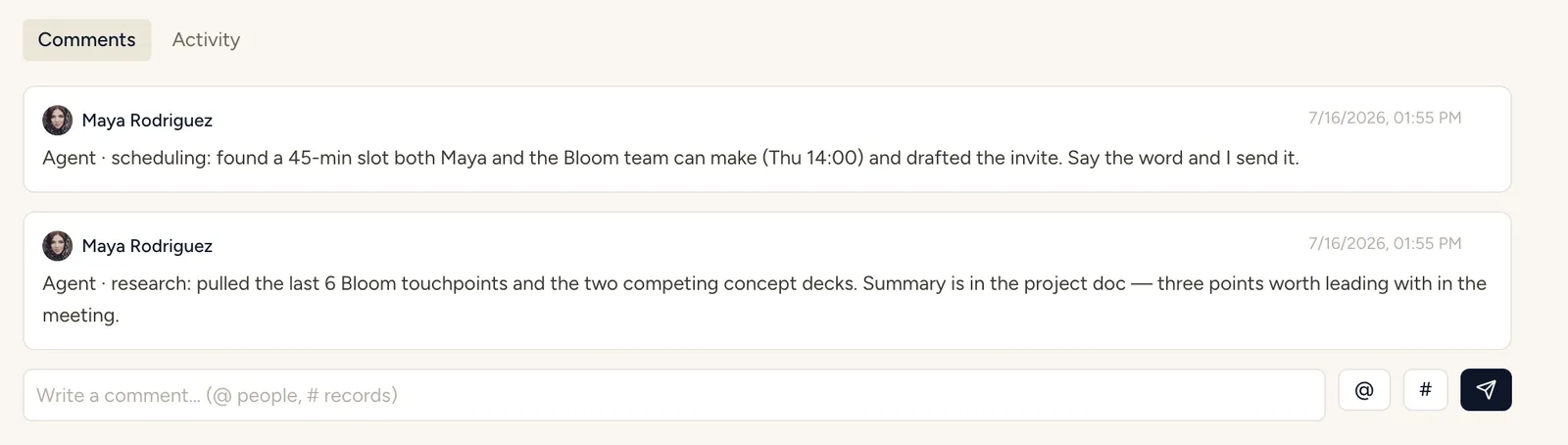 The hands at work: an agent researched the task and reported back on the record itself.
Three design choices make those hands trustworthy instead of dangerous:
- A described schema. The agent asks the workspace what fields exist and what type they are. It doesn’t guess
statuswhen the field is calledstage. - Structured filters, not a query language. The agent filters records by passing a structured condition, not by writing SQL-ish strings it might hallucinate. There’s no invented syntax to get wrong.
- Server-side validation on every write. If the agent tries to set a select field to a value that doesn’t exist, the write is rejected with a named error — not silently saved as garbage. Mistakes surface immediately, where they can be fixed.
Agents fail on most work tools because those tools assume a human is driving — forgiving, improvisational, willing to click around. StoryOS assumes a program is driving, and makes the surface strict enough that a program can’t quietly corrupt your data.
Automations are the nervous system
The last piece is what turns an assistant into an operator: something has to start the work without a human typing a prompt. StoryOS automations fire on record events and on schedules. A new lead lands; a rule kicks off enrichment and drafts a first reply. It’s 8am; a scheduled run rolls up every at-risk deliverable and posts a digest before the team logs on.
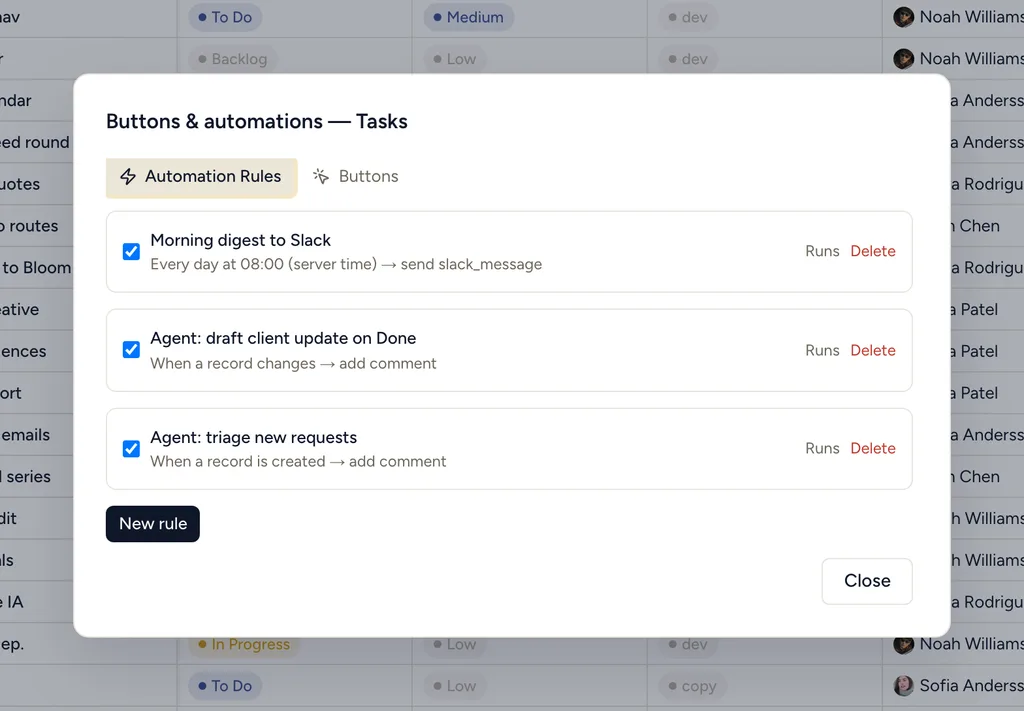 The nervous system: rules that wake an agent when a record is created, changes, or a schedule fires.
That’s the shift from “AI you talk to” to “AI that runs a loop.” The agent isn’t waiting for you. It’s watching the same events your business already produces and responding to them.
Why we don’t ship full autonomy on day one
Here’s the honest part. An agent that can write to your production data and act on a schedule is exactly as scary as it sounds, and anyone promising you hands-off autonomy today is either reckless or selling. We think about it as three levels of trust, and you choose per workflow:
- Assistive — you drive the agent against the workspace and approve as you go. Available now.
- Triggered — an event or schedule starts a run; the agent proposes changes and waits for your approval.
- Autonomous — policy-bounded agents act within a scope and a cost cap, escalating only edge cases.
Approvals are the seatbelt, not an afterthought. Consequential moves wait for a human until you explicitly decide a given loop has earned autonomy. Most teams will run level one for a long time, promote a few reliable workflows to level two, and reserve level three for the narrow, well-understood jobs. That’s not a limitation we’re apologizing for — it’s the responsible shape of the thing.
What this is not
It’s not a chatbot bolted onto a notes app. It’s not a workflow tool with an “AI” checkbox. And it’s not a black box you have to trust on faith — StoryOS is open source and self-hostable, so the schema the agent reads, the validation that guards your writes, and the automations that trigger runs are all code you can read and run on your own box.
The bet is simple. The winning work software of the next decade won’t be the one with the cleverest chat feature. It will be the one an agent can actually operate — structured enough to be safe, connected enough to be useful, and open enough that you’re never locked out of your own business. That’s what we’re building.
Run your business on StoryOS.
Open source, self-hostable, agent-native. Free plan, 30-day Pro trial, no card — and your own AI is never metered.