For sales teams
A pipeline you own — and an agent that keeps it clean.
Accounts, contacts and opportunities as real connected records. Run the board like a deal desk, and let an agent triage, enrich and draft the follow-ups.
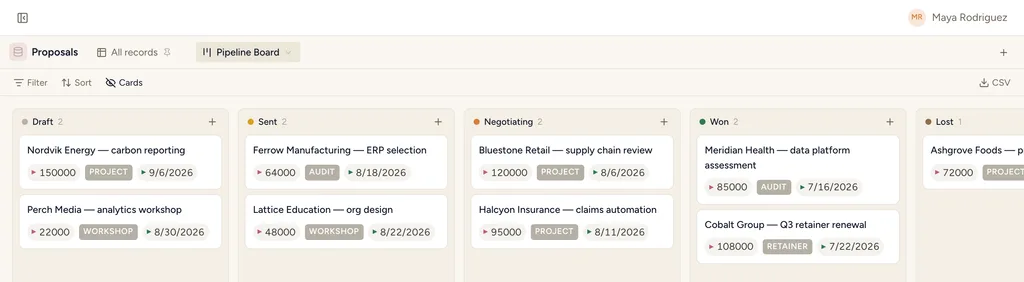
Your CRM is either a rigid box you rent or a spreadsheet that lies.
- Off-the-shelf CRMs force your process into their schema, charge per seat, and lock your relationships behind an export button that strips them.
- The spreadsheet alternative has no stages, no reminders, and goes stale the moment the week gets busy.
- Leads slip through the cracks because nobody enriched, scored or followed up in time.
StoryOS gives you a CRM shaped like your deals — and one you actually own.
Databases
The companies you sell to, with all their context.
People linked to their account and their open deals.
Deals with stage, value and owner, rolled up to the account.
Relations & roll-ups
Contacts link to accounts, opportunities link to both. Roll ups show pipeline value per account and per owner — no add-on, no formula gymnastics.
Views that fit the work
The pipeline: new, qualified, proposal, won — drag to advance.
Every deal, filterable by owner, stage or close date.
Follow-ups and close dates on a grid you can’t ignore.
From "who owns this lead?" to a forecast you can read off a board.
Intake, pipeline, delivery and the follow-up all sit on connected records — so nothing stalls quietly and nobody rebuilds the forecast by hand.
Leads arrive as records, not emails
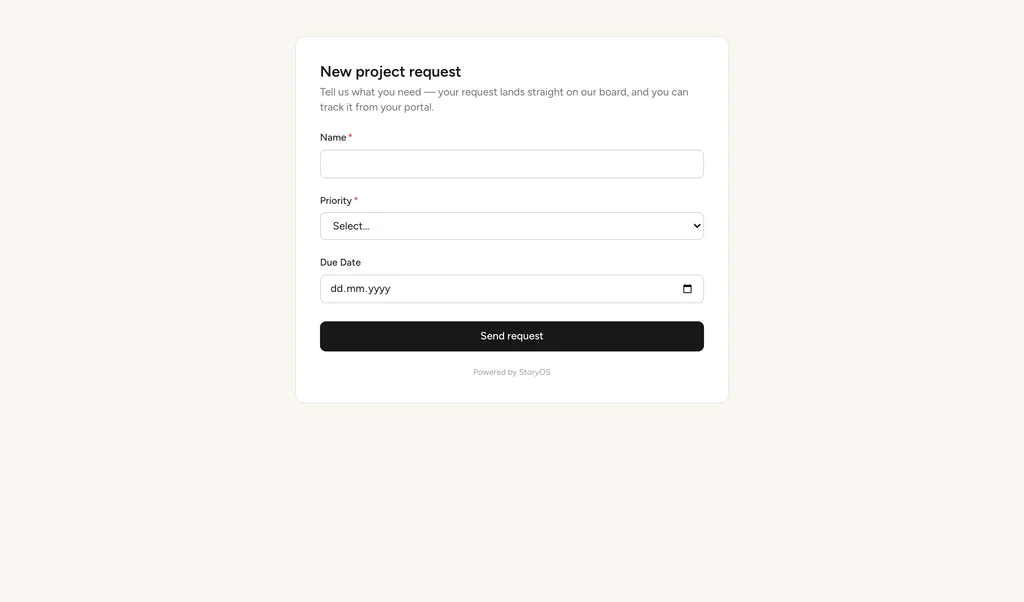
Put a form on your site or send its link. A submission lands as a real opportunity with the fields already set — no copying out of an inbox, no lead sitting unseen for a week.
The pipeline carries the money
Every deal shows its value, type and expected close on the card. Forecasting stops being a spreadsheet exercise — the board already knows, grouped by the stage the deal is genuinely in.
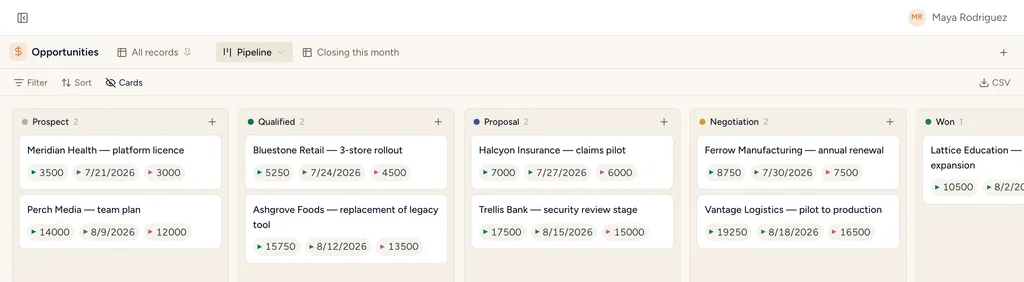
Won deals roll straight up to the account
Move a card to Won and its value rolls up to the account automatically — the forecast reads off the record, not a rebuilt spreadsheet, and there is always a Sales Task with a due date so the handoff never goes quiet.
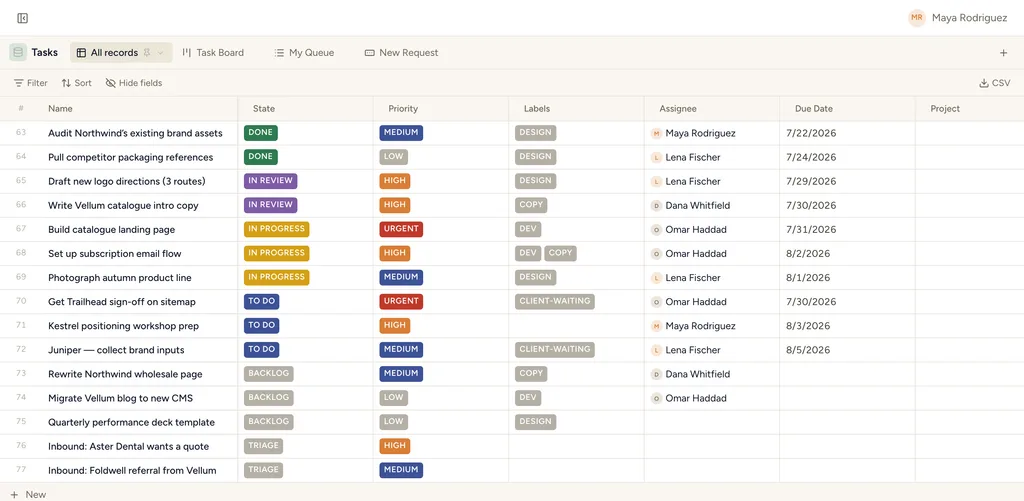
The follow-up is drafted, you send it
An agent watches for deals with no activity, drafts the next touch from what the record already knows, and waits. Nothing reaches a prospect until you approve it.
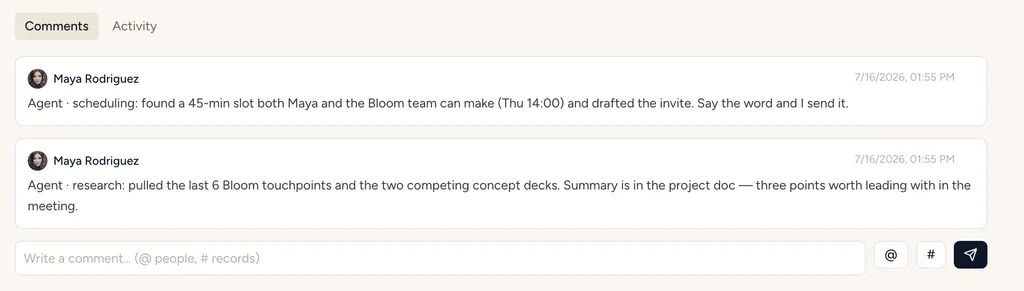
Then let an agent do the triage humans forget.
Because the structure is a described schema, Claude or ChatGPT can work it through the MCP server — grounded in your real records, validated on every write. A few of the loops it runs:
Run sales teams on StoryOS.
Install the “Sales CRM” template and you're editing a working system in minutes. Free, open source, and yours.