One surface for your agents and your code.
MCP for assistants, REST for scripts, the same records and the same filters on both. Rules that start agents, a record of every run, and the skills we use to run our own agent team.
The MCP server and the REST API come with every plan, Free included.
One surface
Everything an agent does, over MCP or REST.
The app is a client of the same public API. An assistant over MCP and a script with a personal access token reach the same workspaces, databases, records and views, with the same permissions.
-
Query
Structured filters and sorts, search, and following links between records. No made-up query language.
-
Create and update
Records with real field names and options, checked on the server. A wrong field is refused by name.
-
Link
Connect a task to its job, a job to its customer, an invoice to both.
-
Comment
Say what changed and why, on the record, where the team reads it.
-
Attach
Files on the record they belong to.
-
Read the schema
Describe a database before writing to it: fields, types, options and relations.
The same filters your AI uses.
A personal access token can be capped at read, write or admin and bound to chosen spaces or databases.
# open tasks due in the next seven days, soonest first
curl -X POST "https://app.storyos.dev/api/v1/workspaces/$WS/databases/$DB/records/query" \
  -H "Authorization: Bearer $PAT" \
  -H "content-type: application/json" \
  -d '{
    "filter": { "and": [
      { "field": "status", "op": "category_is_not", "value": ["completed", "canceled"] },
      { "field": "due", "op": "within", "value": "next_7_days" }
    ]},
    "sorts": [{ "field": "due", "direction": "asc" }]
  }'
Rules and runs
A rule starts the agent. The run keeps the receipt.
An automation rule can run an agent when a record is created or a field changes. Every run keeps what started it, each action it took and each action’s status.
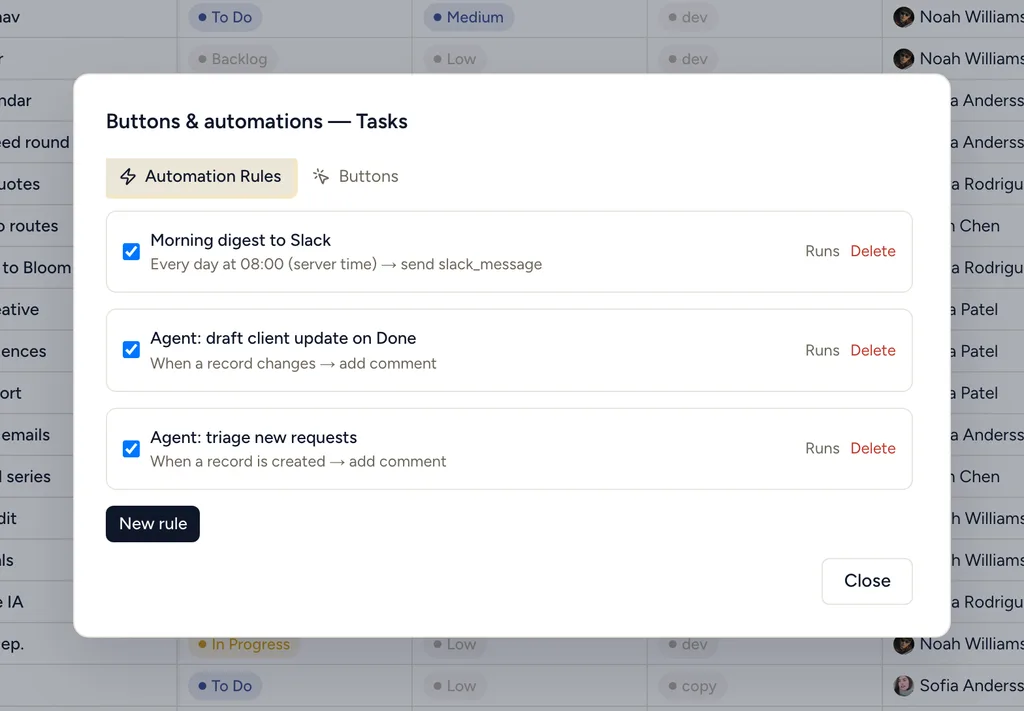
- What started it
- The rule or the event that woke the agent.
- Each action it took
- In order, on the records it touched.
- Each action’s status
- Succeeded, failed, or waiting on approval.


Want agents that run on your own computer, in your own Claude Code? The Runner is in early access, and it is open source: build it from the repo.
Agent teams
Running a whole team of agents?
Six open-source skills for Claude Code that design, provision and run a team of named agents, with a StoryOS workspace as the queue they all work from.
Each agent is its own session with its own queue, a lane it owns, things it must never touch, and someone who checks its work before anything reaches the world. It is the method behind the agent team that builds StoryOS: every rule in the files comes from a specific failure, and the failure is written next to the rule.
-
Phase 0
plan-agent-team
Works out whether you need an agent team at all, and how big. Interviews you, reads what it can from the repo, and proposes a right-sized roster with a phased rollout.
-
Phase 1
agent-fleet
Designs the roster: who exists, what each one owns, what each must never touch, and who checks whom.
-
Phase 2
agent-fleet-provision
Builds the infrastructure: the queue databases in StoryOS and their fields, then each agent’s own workspace.
-
Phase 3
agent-fleet-launch
Starts the fleet: one session per agent, identity checked, queue count verified, then the loop. Also covers stopping it cleanly.
-
Phase 4
agent-fleet-operate
Runs it: the gate that stops unchecked work reaching the world, routing work nobody owns, and a catalogue of silent failures seen so far.
-
Any phase
agent-fleet-marketing
The entry point for a content team: writers per channel, an editor, a fact-checker, an owner who decides what publishes.
Install
Copy the skills into Claude Code, start a new session and say “plan an agent team”. Keep the folders whole:
several skills read files from each other’s references/ directory.
git clone https://github.com/ikrasovytskyi/skills.git
cp -R skills/skills/* ~/.claude/skills/
What you need
- Claude Code
- Each agent is a long-lived Claude Code session.
- A StoryOS workspace as the queue
- Hosted or self-hosted. The provisioning skill creates the databases.
- For an engineering fleet
- A git repository with branch protection, and room for one worktree per agent.
Straight talk about what this is.
- Not a framework
- There is no code to run. These are instructions an agent follows.
- Not one-click
- There is no pre-built pack to install. The provisioning skill builds the queue databases step by step, in your workspace.
- Not finished
- There is no operations profile yet, and the method has mostly been exercised on one engineering fleet and one content fleet. If something fails for you, open an issue.